Tips
Engineered Wood Flooring for Underfloor Heating: What You Need to Know
2026 m. rugpjūčio 12 d.
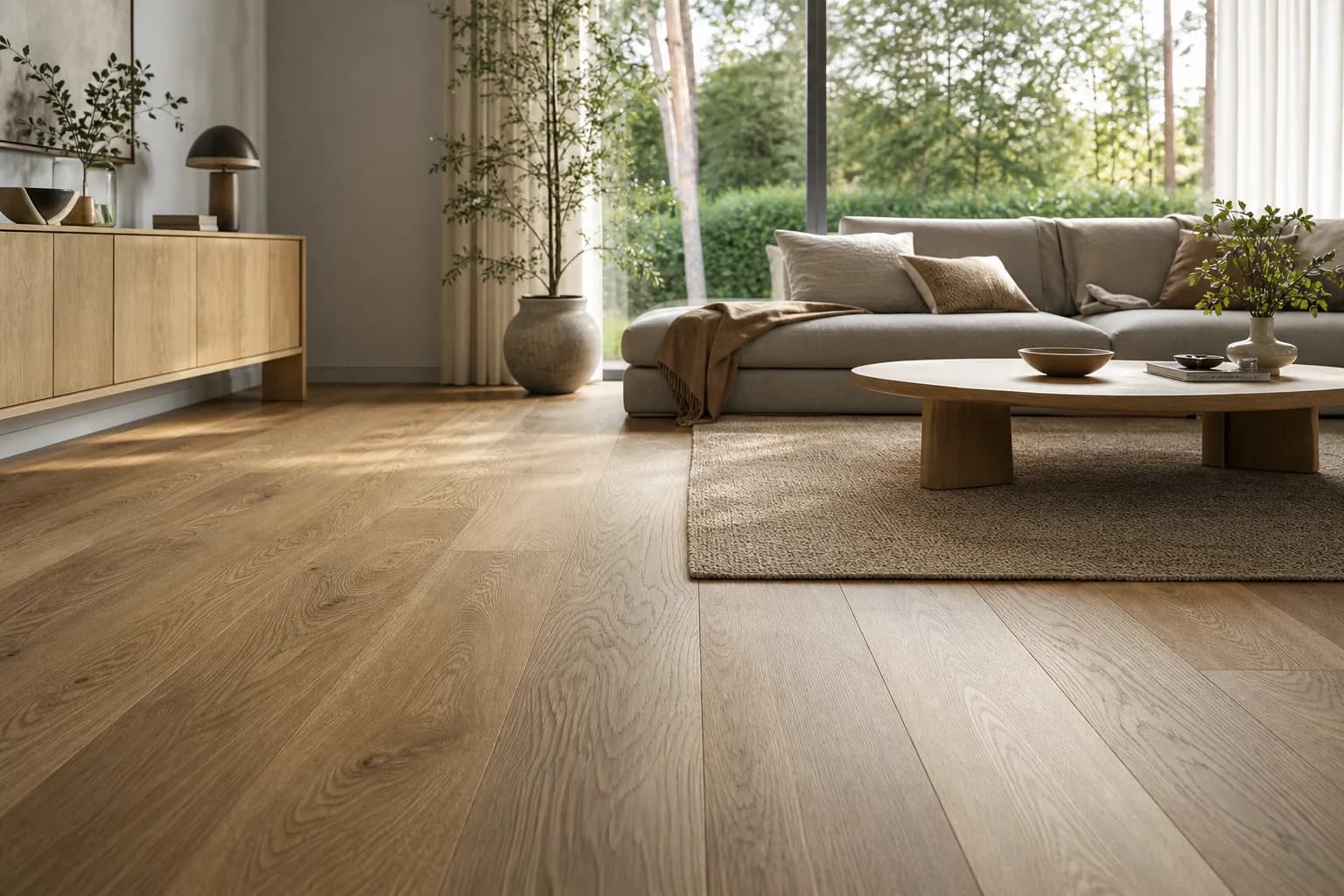
Underfloor heating is a modern heating solution that pays off particularly well in new builds, upgrades and renovation projects. Even heat distribution creates a cosy atmosphere and helps reduce heating bills. But is every floor covering suited to a heated system? In this guide we focus specifically on engineered wood flooring for underfloor heating — how the combination performs, which conditions you need to maintain and which boards are worth choosing.
Why engineered wood is the most popular modern choice for underfloor heating
Unlike traditional radiators, underfloor heating radiates warmth evenly and pleasantly across the entire floor area. And that is not all:
Optimal heat distribution
Warmth rises evenly from the floor and spreads uniformly through the whole room — not just around a radiator.
Space saving and aesthetics
Unlike bulky radiators, underfloor heating is hidden within the floor itself — your home looks elegant and uncluttered.
Allergy-friendly
There is no forced air circulation — so neither dust nor allergens are stirred into the air. That means cleaner air and a healthier indoor climate.
Energy savings
Thanks to even heat distribution, you can maintain a steady room temperature at lower settings. That saves not only energy but money too.
The two types of underfloor heating
There are two main types of underfloor heating: electric and water-based.
Water-based underfloor heating
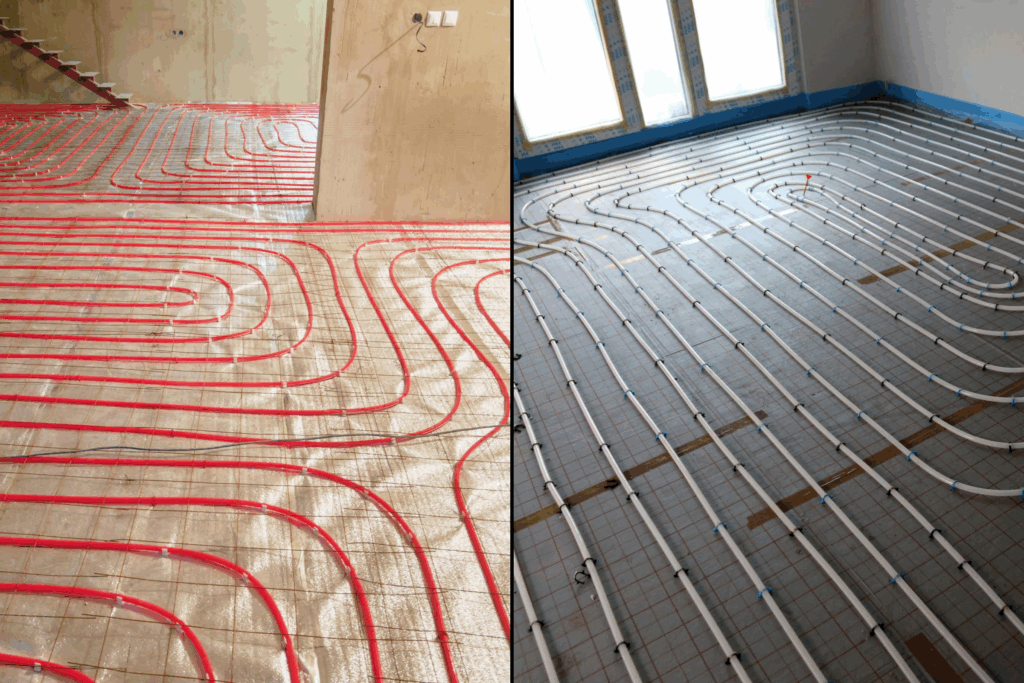
Water-based underfloor heating is supplied with hot water from a central heat source — a gas boiler, a condensing combi boiler or a heat pump. The system delivers exceptionally even heat through pipes laid within the floor. It is not only efficient but especially well suited to larger rooms or a whole building. So that heat transfers quickly and evenly into the floor covering, full glue-down installation is recommended.
Electric underfloor heating
Electric underfloor heating runs on mains electricity — the system consists of thin heating mats or cables laid directly beneath the floor covering. Unlike the water-based version, it can be installed independently, without central heating. The slim construction (as little as 1,3 mm) lets the floor warm up quickly and cool down just as fast. This system is particularly suited to smaller rooms — bathrooms, kitchens — where quick warmth is needed. Installation is done floating, over impact-sound insulation, so the wood has room to expand and contract with temperature changes.
Electric underfloor heating + wood flooring: what you must know
If you are considering electric underfloor heating for your wood floor — make sure you choose a dedicated system designed specifically for heating parquet and wooden floors. Standard systems intended for tiles or concrete are not suitable for wood.
Beyond that, there are 3 key factors that determine the performance and efficiency of electric underfloor heating beneath a wood floor — temperature, air humidity and thermal conductivity. Here are the exact numbers:
1. Temperature
Optimal range: 25 °C – 29 °C
| Min | Ideal | Max |
|---|---|---|
| 25 °C | 26–27 °C | 29 °C |
The operating temperature of underfloor heating beneath a wood floor should be 25–29 °C — warm enough for comfort, without overheating the boards. Never exceed 29 °C.
Excessive temperatures can expand and dry out the wood — with solid wood floors this leads to cracks or even open gaps. With three-layer engineered boards and laminate, high heat can break down the adhesive bond with the wear layer. On the other hand, temperatures that are too low, or cooling that happens too quickly, can cause small gaps to open between boards.
For the floor to warm evenly, the temperature must rise slowly and under control. That is why an electric underfloor heating system needs a thermostat with a floor sensor. The thermostat regulates the heating — switching it on only when needed and off once the maximum floor temperature is reached.
2. Air humidity
Ideal range: 40 % – 60 %
| Min | Ideal | Max |
|---|---|---|
| 40 % | 45–55 % | 60 % |
Wood is a natural material and highly sensitive to air humidity. Air that is too dry can cause shrinkage and cracks, while air that is too humid invites mould and warping. Humidity of 40–60 % is ideal for preserving the appearance and longevity of parquet and wooden floors.
A hygrometer in the room lets you monitor humidity and make sure it stays within the optimal range. Modern underfloor heating systems often come with smart controls that let you fine-tune temperature and running times individually. Regular ventilation, or using a humidifier / dehumidifier, also helps maintain the right humidity level.
3. Thermal conductivity and board thickness
Optimal wood thickness: 10–15 mm (max 18 mm)
| Min | Optimal | Max |
|---|---|---|
| 10 mm | 15 mm | 18 mm |
The thermal conductivity of wood is determined by its density and species. These factors decide how quickly the floor surface warms up. As a general rule: the thicker the wood, the more slowly and unevenly it conducts heat. A thinner layer of wood distributes warmth through the room faster and more evenly — getting the most out of your underfloor heating system.
Suitable species (hardwoods):
- Oak
- Cherry
- Walnut
Less suitable:
- Pine
- Beech
- Larch
- Spruce
Not all wood species are equally suited to electric underfloor heating. Hardwood, especially oak, has higher density and better thermal conductivity, and is less prone to swelling and shrinking than softer species (pine, beech, larch, spruce). The entire Terris Timber engineered wood collection is European oak — so every board we sell is suitable for underfloor heating.
Our recommendation: a water-based system
Thanks to its constant, even heat, a water-based system is a gentler and more efficient heat source for wood flooring than the fast-heating electric version.
That means not only a longer life for your floor but also lower energy consumption. Improper use of an electric system, by contrast, can cause all kinds of damage — cracks, gaps or even delamination of the wear layer due to higher temperatures.
Our tip

All Terris Timber three-layer engineered boards are fully compatible with water-based underfloor heating. Thanks to their multi-layer construction they are exceptionally dimensionally stable and can handle temperature and humidity fluctuations without trouble.
During installation we place great emphasis on fully gluing the boards to the subfloor. Unlike the floating method — where air pockets can form and reduce heating efficiency — a dense adhesive bond ensures heat passes evenly and efficiently into the wooden floor. For this we use professional Berger Seidle M1X adhesive — a one-component PUR adhesive certified to the EC1 Plus emissions standard.
If you are not an experienced fitter, we recommend entrusting the glue-down installation to specialists. Only then can you be sure of the floor's performance and stability — and of the heating system's efficiency.
A quick checklist before installation
- ✓ Three-layer engineered board (not solid wood)
- ✓ Thickness no more than 18 mm (ideally 10–15 mm)
- ✓ Hardwood — oak, cherry or walnut
- ✓ Full glue-down to the subfloor (not floating)
- ✓ Thermostat with a floor sensor
- ✓ Max surface temperature 29 °C
- ✓ Air humidity 40–60 % (measured with a hygrometer)
- ✓ First heat-up after installation — gradually over 7–10 days
How to prepare the heating system before installing engineered boards
This stage is often skipped — and causes problems later. A mandatory heating cycle before installing the boards drives residual construction moisture out of the subfloor and ensures your engineered wood floor settles over the heating without distortion:
- 7 days before installation, run the heating at 22 °C (room temperature).
- Then, over a further 4 days, raise it to the maximum working temperature (but no more than 27 °C at the surface), in 5 °C daily steps.
- 3 days before installation, reduce it to 18 °C.
- Keep it at 18–22 °C throughout the installation.
Subfloor moisture for wood-floor installation must be ≤ 1,8 % by the CM method (for cement screed) or ≤ 0,3 % for anhydrite. Document the measurement — it is a standard requirement if you ever want to claim under the manufacturer's warranty.
Glue down or float engineered boards over underfloor heating?
Full glue-down to the subfloor is the most reliable installation method for engineered wood over underfloor heating, for three reasons:
- Better heat transfer — with no air pockets, warmth passes into the wooden floor more efficiently.
- Smaller expansion gaps — fully bonded boards expand evenly, so there is no need for large perimeter gaps.
- Quieter — no sound reflection from a floating layer.
Floating (click) installation is also possible, but only with a specialised underlay (good thermal conductivity, R ≤ 0,05 m²K/W) and larger perimeter gaps (15 mm instead of the usual 10 mm). For a suitable professional adhesive we recommend Berger Seidle M1X — a one-component PUR adhesive that meets the EC1 Plus emissions standard.
Caring for engineered wood during the heating season
Winter means dry indoor air (below 30 % relative humidity) and significant humidity swings. A few principles to keep an engineered wood floor over underfloor heating in shape for years:
- Keep indoor humidity at 45–60 % — a humidifier will help in the driest weeks.
- Do not push the floor straight up to maximum — raise it over several days in 2–3 °C steps, especially the first time after summer.
- In spring, wind the heating down slowly — a sudden switch-off is just as harmful as a sudden switch-on.
- Avoid rugs over large areas — heat and moisture build up underneath them, and the 29 °C limit can be exceeded locally.
- Furniture on the floor — use self-adhesive felt pads rather than rubber ones (rubber blocks heat and can leave marks).
The best friend of a wood floor over heating is a hygrometer. It shows air humidity in real time and tells you when to switch on the humidifier. It costs 10–20 € and pays for itself within the first heating season.
FAQ: engineered wood flooring for underfloor heating
Is engineered wood really suitable for underfloor heating?
Yes — but only three-layer engineered boards made of hardwood (ideally oak), with a 3–4 mm wear layer, fully glued to the subfloor. Solid wood is not suitable for underfloor heating.
What is the maximum floor temperature under engineered boards?
The surface temperature must never exceed 29 °C; ideally keep it within 25–27 °C. Excessive heat causes cracks in the wood and delamination of the wear layer.
Which system is better for engineered wood — water-based or electric?
A water-based system is the better choice. It delivers even, gentle warmth — kinder to wood. An electric system is also possible, but only with a strict thermostat with a floor sensor and a specialised heating film/cable designed specifically for wood flooring.
Do I need special flooring for underfloor heating?
Any three-layer engineered oak board of a suitable thickness (10–15 mm) with a 3–4 mm wear layer will do. The entire Terris Timber engineered wood collection meets these requirements.
What board thickness should I choose?
10–15 mm is the optimal range; the maximum is 18 mm. Thinner boards conduct heat better; thicker boards reduce heating efficiency and increase thermal resistance.
How do I protect the boards from cracking during the heating season?
Three things matter most: (1) keep air humidity at 45–60 % (use a humidifier), (2) never exceed a floor surface temperature of 29 °C, (3) switch the heating on and off gradually over 7–10 days — never abruptly.
Can engineered boards be floated over underfloor heating?
Yes, but full glue-down is the more reliable solution. Floating installation requires a specialised underlay (R ≤ 0,05 m²K/W) and larger perimeter gaps (15 mm).
Ready to get started?
All Terris Timber engineered boards are three-layer, oak, and suitable for both water-based and electric underfloor heating (provided the requirements above are followed). Our most popular choices for underfloor heating are Oak Bergen (matt lacquer, easy care), Oak Vienna (oiled, country style) and Oak Innsbruck (rustic character).
Order up to 3 free samples — see the true wood surface and colour in your own home's lighting within 5–7 working days. Or book a video consultation — together we will go through your drawings and heating-system parameters and pick the best option for your project.